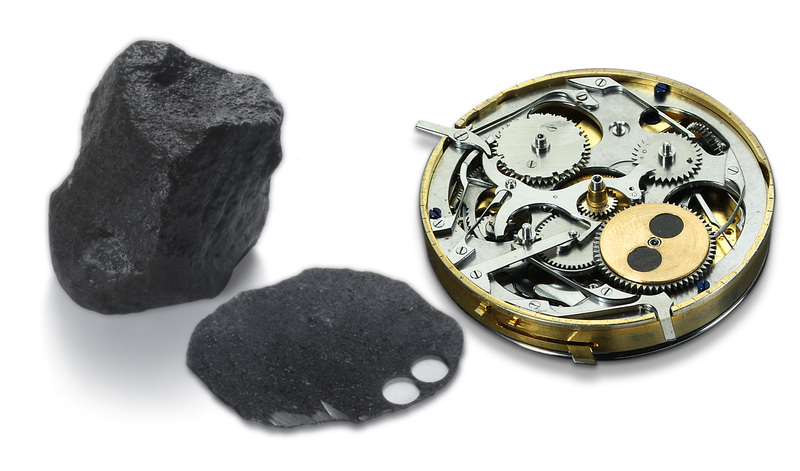
A hundred-year-old movement, an authentic 2000-year-old piece of the moon, a box that works like a musical instrument, the famous 1848 Traite d'Horlogerie (Watchmaking Treatise) - dreams are ever present in the history of this watch.
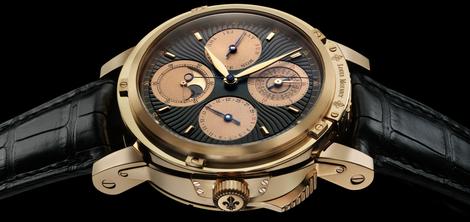
Magistralis is an extraordinary watch representing the expert craftsmanship of the time-honoured art of Haute Horlogerie. It is one of a kind, unlike any other, and will never be repeated.
The movement
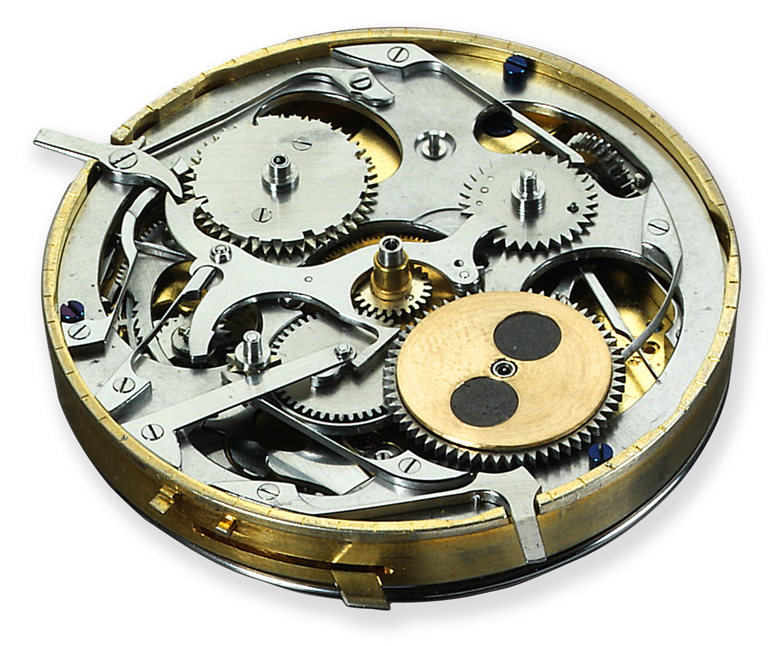
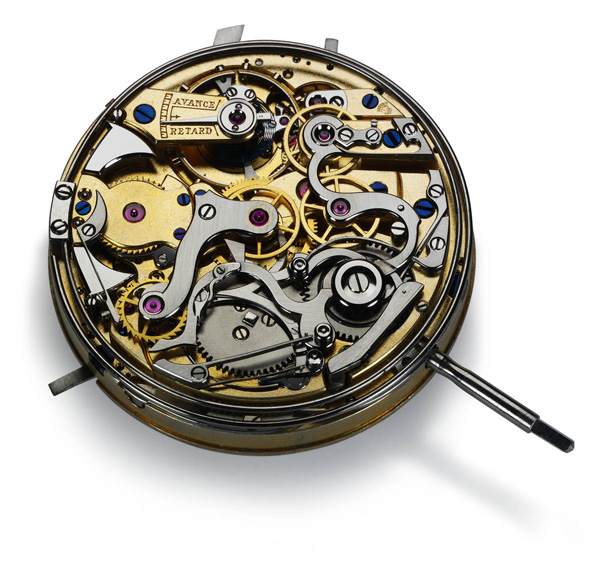
The movement was created a hundred years ago. Designed in the Vallee de Joux, it was made in Geneva and bears the Poincon de Genève quality hallmark. It beats at 18,000 vibrations per hour and features a (double-bladed) self-compensating balance and a flame-blued Breguet balance spring. Its flat-polished moustache lever escapement is hand chamfered and mounted on an endstone.
The chronograph
The single-button column-wheel chronograph (6 columns) has a spring-assisted lever. The instantaneous jumping minute hand, a very distinctive mechanism, operates by means of a cam. The function of the cam is to load the minute lever by means of constant friction, thereby stabilising regulator operation (by avoiding loss of amplitude) when the chronograph function is activated. This technique is no longer used now, given the complexity of its entirely manual fine-tuning.
The striking mechanism
The striking mechanism comprises two hammers that sound the hours, quarter-hours and minutes, as well as an "all or nothing" lever. The mechanism for activating the striking mechanism is operated by pressing a lever, so as to facilitate handling of the repeater slide, which is always a delicate operation on traditional watches. The making of a striking mechanism will always remain a manual operation that simply cannot be industrialised. Indeed, the extreme accuracy of the adjustments required for this complication can neither be done by machine nor measured; they truly do come from the watchmaker's hand, ear and heart. For this reason, two identical striking mechanisms will sound different, precisely because they are adjusted by hand. The creation of a striking mechanism quite obviously requires all the experience of a skilful and knowledgeable master-watchmaker.
The perpetual calendar
The perpetual calendar function displays the day, date and month over four years. Its unique feature is its small size, as the perpetual date mechanisms of the period were usually much larger. All of the steel parts of the bridges are polished with a tin block to achieve a perfect polish and coldwork the material so as to eliminate any cracks and thus protect it from oxidation with no need for any additional treatment. That is why these century-old steel parts are still as perfect as ever.
The moon phase
Louis Moinet is presenting a world first, a lunar phase complication with real pieces of the moon! These pieces are from a lunar meteorite that was ejected from the moon 2,000 years ago. The meteorite, which has been authenticated by the University of California, actually added to our knowledge of lunar geology, since it came from a place that the Apollo missions did not visit. Moonstone is an extremely rare material that is even more expensive than gold and platinum combined.
The case
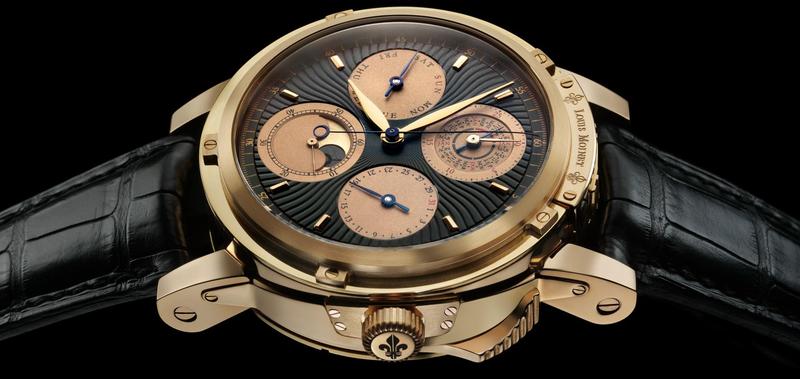
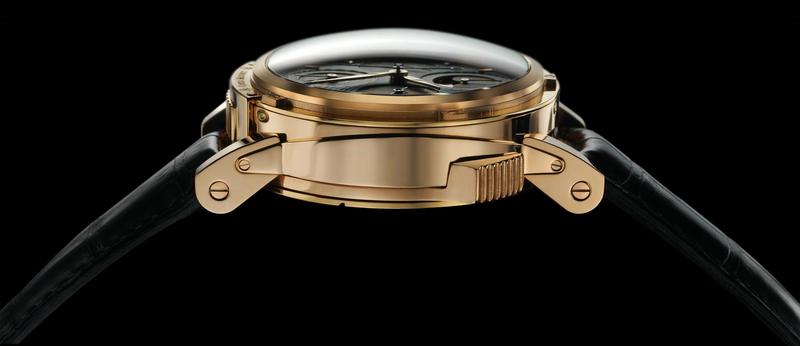
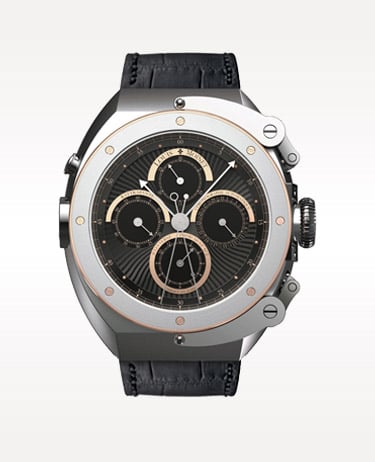
The case is made of 5N and 3N 18-carat rose gold. Its brand-signature design stands out especially for its crown guard (patent pending) and its chronograph button guard at 12 o'clock. The 90-part case is extremely complex to make. It features a pressure-controlled striking-mechanism lever, which makes the slide easier to manipulate. The various correctors are marked with the Louis Moinet symbols so their purpose is obvious.
The dial
The dial is adorned with the "Cotes du Jura" motif, an exclusive creation from the Ateliers Louis Moinet. The four counters are hollowed and their "old rose" shade ensures excellent readability of the indications provided by the century-old flame-blued steel hands.
The box
An extraordinary watch deserves an extraordinary box! The box is entirely hand-crafted from curly maple by luthier Claude Bourquard, from the Jura. Claude has a thorough knowledge of resonance, acquired by making guitars and violins of the highest quality by hand. He has used this knowledge to design a true musical instrument using the watch support. Once the striking mechanism has been activated, the instrument amplifies its sound so the tone can be fully appreciated. This instrument is made of curly maple and varnished spruce, and Claude jealously safeguards the secrets of its manufacture, which make it a unique object.
The 1848 Traite d'Horlogerie
An original of the Traite d'Horlogerie by Louis Moinet is also included in the box. This is the second edition, dated 1856. This book has the reputation of being the most beautiful of its century, and describes the best watchmaking techniques. It is illustrated by dozens of pages of watch mechanisms hand-drawn by Louis Moinet.
So the circle is complete, and everything surrounding this creation is truly extraordinary...
MAGISTRALIS, Limited Edition of 1
LM-15.65.50/50 5N and 3N 18-carat rose gold Black dial
PRICE: CHF 1,000,000.00 (one million swiss francs or 820,000 U.S. dollars)
Louis Moinet collections


Latest News from Louis Moinet
Louis Moinet Mogador Tourbillon





The house of Louis Moinet introduces two exclusive sets of artistic watches – the Mogador Tourbillon. The idea behind the release is to show the Maison’s two new colors – Moinet blue, and Polar silver – by combining their energy in a powerful creation that shows off the intensity of these hues. The gorgeous blue dial features the concentric Clous de Paris pattern, a special type of guilloche that features hollowed lines that intersect to form tiny pyramids. The magnificent tourbillon is placed at its traditional position, at 6 o’clock, while...
Louis Moinet 20-Second Tempograph Chrome




One of the greatest successes of the house of Louis Moinet is certainly its 20-second Tempograph. This exclusive model that beautifully embodies all Louis Moinet’s values, consists of a series of limited editions and unique pieces, of which several versions have sold out and are now collectors’ items. This year, following up on the success of the original Tempograph, Louis Moinet introduces the Tempograph Chrome, which includes two major firsts: a completely black or blue exterior, and the first stainless steel case for the blue version. The...
Louis Moinet Skylink




Louis Moinet is unveiling a new timepiece commemorating the accomplishments of the great Russian cosmonaut Alexey Leonov. Following on from the Spacewalker satellite tourbillon, the famous Swiss watchmaker is introducing the Skylink, a second creation dedicated to Leonov’s 1975 Apollo-Soyuz mission. The Apollo–Soyuz Test Project was the first joint mission between the Soviet Union and the United States of America. The mission began at Baikonur Cosmodrome in Kazakhstan, where Soyuz launched carrying cosmonauts Alexey Leonov and Valery Kubasov...
Louis Moinet Space Mystery




The house of Louis Moinet introduces the world’s first satellite tourbillon, named Space Mystery. The watch is a powerful tribute to the astronomical passion of Louis Moinet, and what makes it truly unique is that its cage is balanced by means of a tiny planet that revolves around it. After having shown off fragments of the Moon, Mars, and the oldest known rock in the solar system, Louis Moinet now incorporates the carbonaceous CM chondrite meteorite into its latest creation. These authentic fragments of a mysterious meteorite hold traces of am...
The Whisky Watch by Louis Moinet and Wealth Solutions





The house of Louis Moinet has partnered with Wealth Solutions, a Polish company that specializes in luxury collectibles, for a very special timepiece - the Whisky Watch. This utterly luxurious timepiece contains a sample of the oldest whiskey in the world, Old Vatted Glenlivet 1862, inside! The bottle of Old Vatted Glenlivet is reputed to be the oldest whiskey in the world Self-described as an expert in building collections of rare alcoholic beverages, works of art, and watches, Wealth Solutions is also the founder of the Spirit Watches line...
Louis Moinet Memoris Red Eclipse Limited Edition




On the occasion of the eclipse of the Moon, which occurred on September 16, the house of Louis Moinet has organized an exceptional astronomy event entitled “200 years in 24 hours,” at the famous Neuchâtel Observatory. This was the perfect opportunity to pay tribute to Louis Moinet’s anthology timepiece, Memoris Red Eclipse, by unveiling an extremely small limited edition of 12 fully hand-engraved watches. This extraordinary watch has also been shortlisted for the prestigious Geneva Grand Prix d’Horlogerie, in the Chronograph category. This y...
Louis Moinet Sideralis timepiece





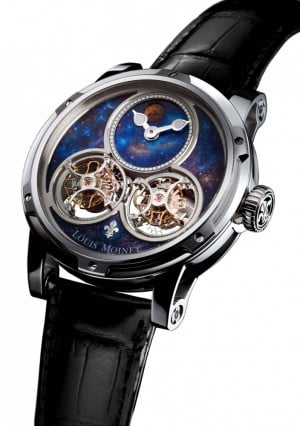
The Sideralis timepiece is built around two extraordinary tourbillons, both of them oversized with their cages measuring 14,9 mm. This is the largest assembly of two tourbillons ever created, which adds a captivating visual aspect to the watch, allowing the watch lovers to admire and contemplate horological art in all its splendor. A photo posted by Louis Moinet (@louismoinet) on Mar 21, 2016 at 3:33am PDT The tourbillons are positioned above the movement, and even above the dial, placed in two raised, fully visible cages. In...
Louis Moinet Memoris 200th Anniversary timepiece





On the occasion of the BaselWorld 2015 trade show, the house of Louis Moinet introduced a new collection designed in honor its founder, Louis Moinet, who will be remembered as the inventor of the chronograph. The Memoris timepiece was introduced as the most important launch the house of Louis Moinet has ever done. For the brand, it represents a historic crossroad - the Ateliers’ tenth anniversary, and the bi-centenary of the chronograph invented by Louis Moinet. For 2016, the Memoris collection welcomes a new addition, the first chronograph-wat...
Louis Moinet UAE Falcon

On the occasion of the Dubai Watch Week, In October 2015, the house of Louis Moinet revealed the UAE Falcon, a model designed as a tribute to the United Arab Emirates. This special Louis Moinet timepiece commemorates the first edition of the Dubai Watch Week, bearing a powerful emblem – a pure platinum falcon, which is the symbol of the Unitd Arab Emirates. Falcon is the national bird of UAE and, a symbol of force and courage. In Arabic, its name means „purebred bird.“ Falconry holds the most prominent place in Arab tradition and culture, while...
Louis Moinet Memoris


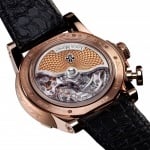


On the occasion of the BaselWorld 2015 trade show, the house of Louis Moinet launched the Memoris timepiece, a watch that is announced as the most important launch the brand has ever done. As explained by Jean-Marie Schaller, CEO of Louis Moinet, this extraordinary timepiece celebrates the Ateliers’ tenth anniversary, and the bi-centenary of the world’s first chronograph, which was invented by Louis Moinet. In 2015, the Manufacture presents what is described as the first chronograph-watch in history, with the chronograph as the primary...