
The world's official timekeepers have added a "leap second" to the last day of the year on Wednesday, to help match clocks to the Earth's slowing spin on its axis, which takes place at ever-changing rates affected by tides and other factors, Reuters reports.
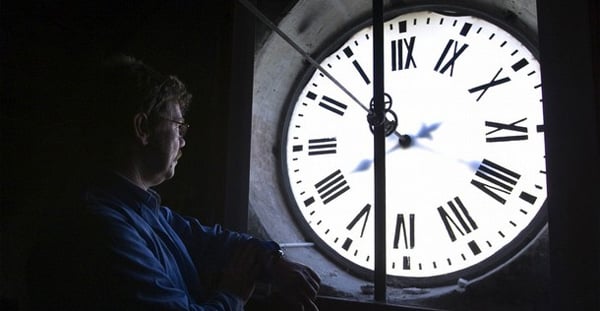
The U.S. Naval Observatory, keeper of the Pentagon's master clock, said it would add the extra second on Wednesday in coordination with the world's atomic clocks at 23 hours, 59 minutes and 59 seconds Coordinated Universal Time, or UTC.
That corresponds to 6:59:59 p.m. EST (23:59:59 GMT), when an extra second will tick by -- the 24th to be added to UTC since 1972, when the practice began.
UTC is the time scale kept by highly precise atomic clocks around the world, accurate to about a billionth of a second per day, the Naval Observatory says. For those with a need for precision timing, it has replaced Greenwich Mean Time, or GMT.
The decision to add or remove a second is the responsibility of the International Earth Rotation and Reference Systems Service, based on its monitoring of the Earth's rotation.
The goal is to make sure clocks vary from the Earth's rotational time by no more than 0.9 seconds before an adjustment. That keeps UTC in sync with the position of the sun above the Earth.
Mechanisms such as the Internet-based Network Time Protocol and the satellite-based Global Positioning System depend on precision timing.
The first leap second was introduced into UTC on June 30, 1972. The last was added on December 31, 2005.
They have been added at intervals ranging from six months to seven years, Daniel Gambis, head of the IERS Earth Orientation Center at the Observatoire de Paris, wrote in an explanatory piece this month (http://hpiers.obspm.fr/eop-pc/).
Among the reasons for Earth's slowing whirl on its axis are the braking action of tides, snow or the lack of it at the polar ice caps, solar wind, space dust and magnetic storms, according to the U.S. Commerce Department's National Institute of Standards and Technology, another timekeeper.
By contrast, a leap day, February 29, occurs once every four years because a complete turn around the sun -- our year with all its seasons -- takes about 365 days and six hours.
In 1970, an international agreement established two time scales: one based on the Earth's rotation and another on highly accurate atomic clocks.
The U.S. Naval Observatory's master clock is based on a system that now includes 50 atomic clocks, 36 based on the element cesium and 14 known as hydrogen masers.
With the Earth's rotation gradually slowing, the periodic insertion of a leap second into the atomic time scale is needed to keep the two systems within a second of each other.
