
Professor Christian Robert of the Haute Ecole Arc Ingénierie, and his students, have designed a new mechanical system for complicated watch movements.
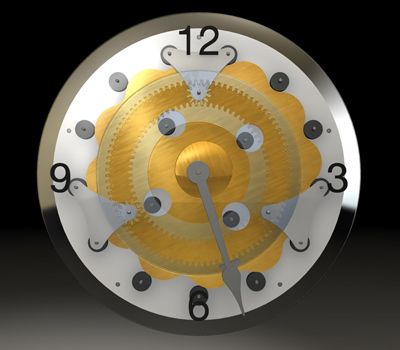
The new system uses a cycloid reduced instead some of the wheels and pinions. This mechanism was invented in 1926 by the German Lorenz Braren and initially used in heavy mechanics for reducing the speed of an input shaft by a certain ratio. The cycloid reducer provides exceptional yield (95% per stage) and the transmission of the movement involves only bearings. This means that there is no friction on the sides of the teeth, and the low inertia makes it possible to use low power motors.
Here is how it works:
An eccentric is keyed onto the input arbour, the ring of which is fitted with cylindrical rollers. This assembly is set on ball bearings in the input flange. There is a boring in the centre of the disc-cam, which fits over the rollers of the eccentric and around the edge of the disc-cam is a succession of cycloidal scallops, the number of which determines the reduction ratio. In the middle, there is a series of borings which connect with the output arbour.
The internal diameter of the ring-shaped crown bears a series of axes, being 1 more in number than that of the cycloidal scallops of the disc-cam. The inside of the output arbour is fitted with the reducer plate provided with pins enclosed in sheaths. It is these pin-and-sheath assemblies which engage in the scallops reamed around the edge of the disc-cam.
The primary movement applied to the input arbour and its eccentric causes the disc-cam to roll on the axes of the crown. As the number of axes is 1 higher than the number of cycloidal scallops of the disc-cam, the disc-cam moves back by one scallop (one step) at each rotation of the eccentric. The uniform rotational movement of the disc-cam is transmitted to the output arbour via the pin-and-sheath assemblies of the arbour plate. The reduction ratio can be considerable, 85:1 for a single stage.
